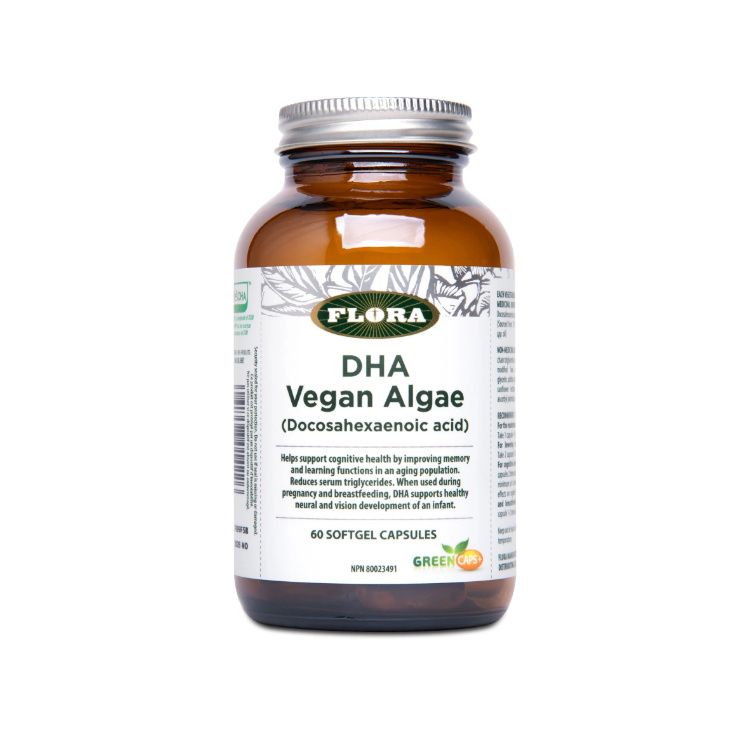
• Sustainable, vegetarian DHA from algae (Schizochytrium), a clean, fish-free alternative to fish oils.
• DHA supports healthy neural and visual development in infants when used during pregnancy and breastfeeding.
• Supports cognitive health in aging adults by promoting memory and learning. It also helps reduce serum triglycerides for heart health.
• Small, easy-to-swallow softgels; 60 softgels per bottle for convenient daily DHA supplementation.
Popular Searches
Top Brands
Available in store
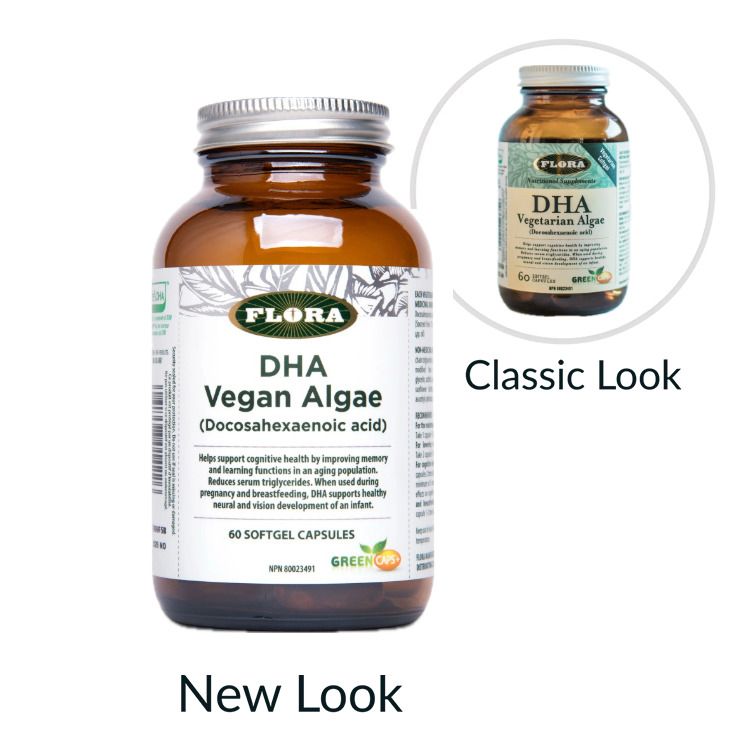
Flora, Vegetarian Algae DHA, 60 Softgels
Size
60
softgels
UPC
061998014226
Best Before
12/2028
61 people have viewed this item in the last 7 days
About this item
Suggested Use
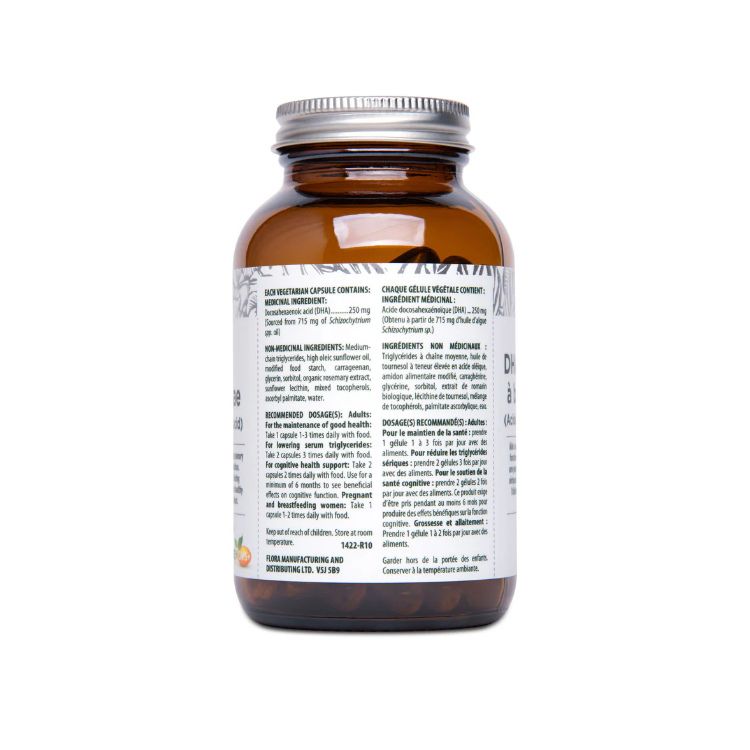
Adults: For the maintenance of good health:Take 1 capsule 1-3 times daily with food. For lowering serum triglycerides: Take 2 capsules 3 times daily with food.
For cognitive health support: Take 2 capsules 2 times daily with food. Use for a minimum of 6 months to see beneficial effects on cognitive function.
Children 6-10 years old (For improving reading & behaviour): Take 3 capsules daily with food.
Children 6-18 years old (For the maintenance for good health): Take 1 capsule 1-2 times daily with food.
Pregnant and breastfeeding women: Take 1 capsule 1-2 times daily with food.
For cognitive health support: Take 2 capsules 2 times daily with food. Use for a minimum of 6 months to see beneficial effects on cognitive function.
Children 6-10 years old (For improving reading & behaviour): Take 3 capsules daily with food.
Children 6-18 years old (For the maintenance for good health): Take 1 capsule 1-2 times daily with food.
Pregnant and breastfeeding women: Take 1 capsule 1-2 times daily with food.
Ingredients
Each softgel contains:
DHA (Sourced from 715 mg of Schizochytrium spp. oil)
250
mg
Non-medical Ingredients:
Medium-chain triglycerides, high oleic sunflower oil, modified food starch, carrageenan, glycerin, sodium carbonate / sorbitol,rosemary extract, sunflower lecithin, mixed tocopherols, ascorbyl palmitate, purified water
Description
Looking to up your omega-3s sustainably? Go straight to the source with Flora DHA Vegetarian Algae. Fish get their omega-3s from eating algae, so we're cutting out the middle man (or fish, rather) and bringing you a vegetarian, sustainable alternative to fish oils. Flora's blend provides DHA supplementation, essential for the proper functioning of our brains as adults, the development of the nervous system and visual abilities during the first six months of life, and key for pregnant and nursing women.
- Source of DHA (Omega-3 fatty acid) for the maintenance of good health.
- Reduces serum triglycerides.
- When used during pregnancy and breastfeeding, DHA supports healthy neural and vision development of an infant.
- Helps support cognitive health by improving memory and learning functions in an aging population.
- Helps to improve reading performance and behavior (restless-impulsive, oppositional, hyperactivity and mood swing) in underperforming children aged 6-10.
- Improves reading ability and some attention deficit hyperactivity (ADHD)-type behavioral symptoms (restless-impulsive, oppositional, hyperactivity and mood swing) in underperforming children aged 6-10.
- Clinically proven to improve reading ability in underperforming children aged 6-10.
Frequently Asked Questions
What is Flora Algae DHA, and why is algae-derived DHA different from fish oil?
Flora Algae DHA is a 100% plant-based DHA supplement providing 250 mg of DHA per softgel capsule, derived from 750 mg of Schizochytrium microalgae oil. It contains no fish products, making it suitable for vegetarians, vegans, and individuals who avoid fish for dietary, ethical, or religious reasons. Algae-derived DHA is the original and primary source of DHA in the ocean's food chain — fish accumulate DHA by eating algae and smaller marine organisms, not by synthesizing it themselves. Sourcing DHA directly from algae bypasses the fish food chain entirely, eliminating the risk of heavy metal bioaccumulation (mercury, PCBs, dioxins) that is inherent in fish-derived omega-3 products. The algae used — Schizochytrium — is cultivated under controlled fermentation conditions, ensuring consistent purity and potency without dependence on ocean fishing. Flora Algae DHA is certified organic by QAI, Non-GMO Project Verified, and holds kosher certification. The product is manufactured by Flora Health, a Burnaby, British Columbia company founded in 1965.
How does DHA support brain development, pregnancy health, and cognitive function?
DHA (docosahexaenoic acid) is a structural omega-3 fatty acid that comprises approximately 40% of the polyunsaturated fatty acids in the brain and 60% in the retina. It is not optional for these tissues — DHA is incorporated into cell membranes where it maintains fluidity, supports signal transmission between neurons, and facilitates the function of ion channels and receptors critical for cognitive processing. During pregnancy and breastfeeding, maternal DHA status directly determines fetal brain and retinal DHA supply, since the developing brain cannot synthesize adequate DHA from precursor fatty acids. Clinical research associates higher maternal DHA intake with better infant visual acuity, cognitive development scores, and reduced risk of preterm birth. The DHA to EPA ratio in this product is approximately 20:1 — an unusually high DHA proportion relative to EPA — which makes it particularly suitable for pregnancy and infant development applications where DHA specificity matters most. In adults, DHA supports memory consolidation, learning capacity, working memory, and mood regulation, with established evidence for maintaining cognitive performance in aging adults.
Who should take Flora Algae DHA, and what are the recommended doses for different life stages?
Flora Algae DHA is appropriate for a wide range of individuals across different life stages. Pregnant and breastfeeding women: 1 to 2 capsules daily with meals — the high DHA-to-EPA ratio is specifically suited to this use. Children aged 6 to 10 for cognitive support: 3 capsules daily with meals. Adolescents aged 6 to 18 for general maintenance: 1 to 2 capsules daily. Adults for general cardiovascular and cognitive maintenance: 1 to 3 capsules daily. Adults specifically seeking triglyceride reduction: 2 capsules 3 times daily (6 per day) with meals. Adults targeting improved cognitive function: 2 capsules twice daily for at least 6 continuous months. The algae oil format is equally tolerable on an empty or full stomach compared to fish oil, which is prone to fishy reflux when taken without food. The plant-based capsule shell makes it suitable for vegans and vegetarians.
How does Flora Algae DHA compare to fish oil products for DHA supplementation?
Fish oil products dominate the omega-3 market but have structural disadvantages that algae DHA specifically avoids. First, contamination risk: ocean-caught fish bioaccumulate heavy metals and persistent organic pollutants up the food chain, requiring molecular distillation to remove contaminants — a process that degrades some omega-3s. Algae cultivated in controlled fermentation tanks has no ocean contamination exposure. Second, fish oil contains EPA and DHA in variable ratios, typically with more EPA than DHA — which is appropriate for anti-inflammatory and cardiovascular applications but suboptimal for pregnancy DHA-specific needs. Flora Algae DHA's 20:1 DHA:EPA ratio is specifically relevant for fetal neural development where DHA, not EPA, is the primary need. Third, sustainability: commercial fish oil production contributes to overfishing and marine ecosystem pressure, while Schizochytrium algae cultivation is fully land-based and requires no fishing. Fourth, tolerance: fish oil frequently causes fishy burping and aftertaste, which reduces compliance; algae DHA has no marine smell or taste. For vegans, vegetarians, pregnant women prioritizing DHA specificity, and those sensitive to fish oil taste or sustainability concerns, algae DHA is the superior alternative.
What is Flora Health and what does the brand offer?
Flora Health is a Canadian nutraceutical brand established in 1965 and headquartered in Burnaby, British Columbia. The brand specializes in whole-food supplements, full-spectrum botanical extracts, cold-pressed seed oils, and European-style health tonics. Flora's product range includes omega oils, herbal tinctures, digestive bitters, fermented preparations, and superfood formulas. The brand is certified organic by QAI (Quality Assurance International), Non-GMO Project Verified, and Kosher certified. All raw materials are tested in-house for microbial content, heavy metals, pesticide residues, and active ingredient levels.
What sets Flora Health apart from other supplement brands in Canada?
Flora Health's most distinctive characteristic is its European health tonic heritage. The brand was among the first in North America to import and produce traditional European remedies — including Swedish bitters and fermented preparations — that draw on centuries of botanical medicine tradition. Unlike most supplement brands that focus on isolated vitamins or single-ingredient extracts, Flora has historically formulated multi-herb complexes rooted in European and Ayurvedic herbalism. As a privately owned, vertically integrated Canadian manufacturer operating for nearly 60 years, Flora maintains sourcing and production control that is rare among brands of its size.
The information provided above is for reference purposes only and has not been reviewed or approved by Health Canada. It does not constitute medical advice and should not replace consultation with a qualified healthcare professional.
Caution
This product is not intended to diagnose, treat, cure, or prevent any disease.
Disclaimer
You should not use the information or services on this Site to diagnose or treat any health issues or for prescription of any medication or other treatment.
Always check the product label or packaging prior to using any product. If there are discrepancies, customers should follow the information provided on the product label or packaging.
Flora, Vegetarian Algae DHA, 60 Softgels
Size
60
softgels
UPC
061998014226
Best Before
12/2028
61 people have viewed this item in the last 7 days
$33.39
Quantity
Not enough inventory in stock
Purchase limit exceeded
In-Store Purchases
In stock at LIFEPLUS Natural Health
#1825 - 4720 Mcclelland Rd, Richmond, BC
Free in-store pickup available
Ready by
Today, Oct 21
⏱️
Shipping Options
Available to ship
Estimate Ship Date
Today, Oct 21
⏱️
Metro Vancouver
Free Shipping Over $69
Within Canada
Free Shipping Over $99
United States
Mainland China
Starting from $9
Related Products
-
-
-
-
-
-
-
$24.95
-