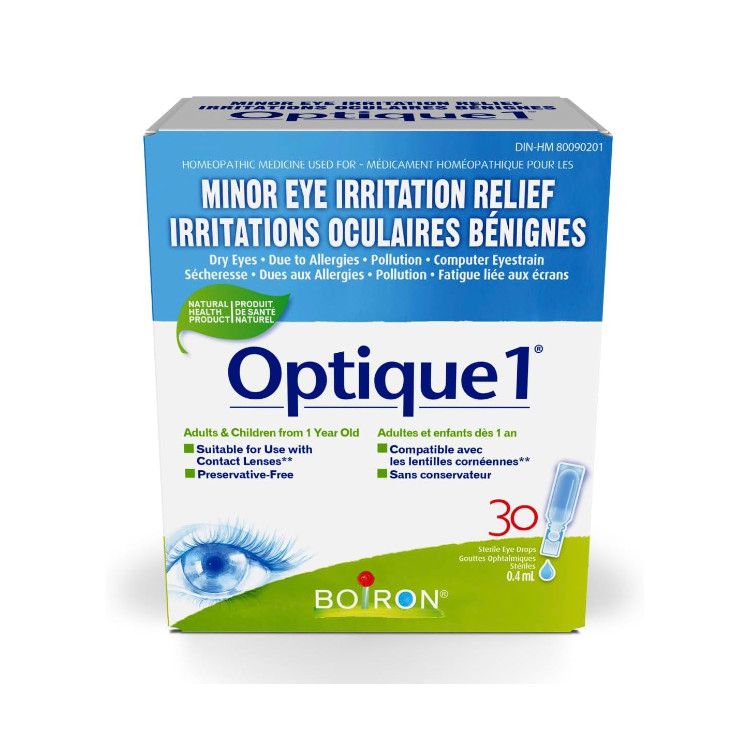
• Relieves multiple minor eye irritations—from dryness, burning, redness to itching—caused by allergies, pollution, strain, or swimming.
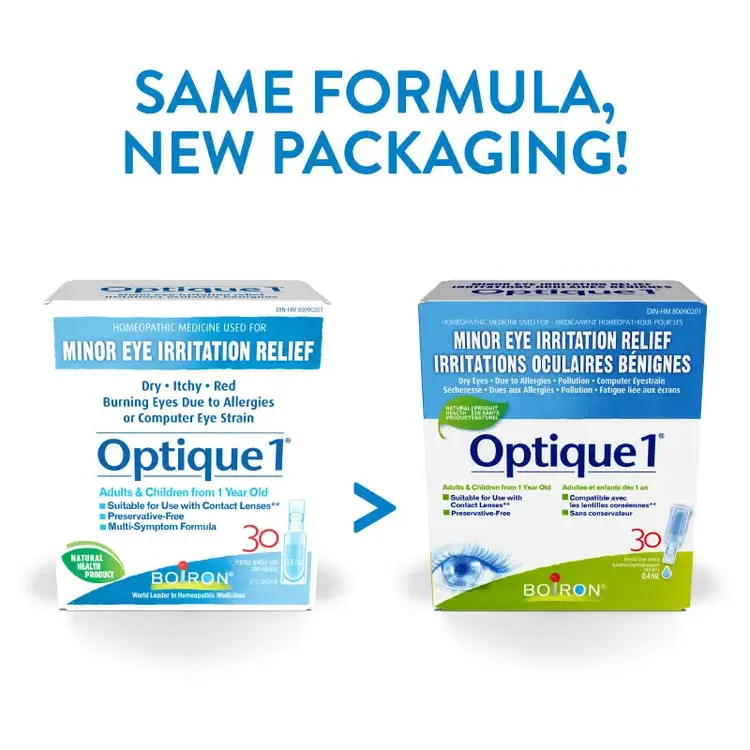
• 30 pre-measured 0.4 mL unit-doses, preservative-free and suitable for use with contact lenses.
• Natural homeopathic formula featuring Calendula officinalis, Euphrasia officinalis, and Magnesia carbonica for gentle ocular comfort.
• Convenient, travel-friendly solution for on-the-spot, multi-symptom eye relief.
Popular Searches
Top Brands


Available in store
Boiron, Optique1, 30 Doses
Size
30
doses
UPC
774016840942
Best Before
10/2028
47 people have viewed this item in the last 7 days
About this item
Suggested Use
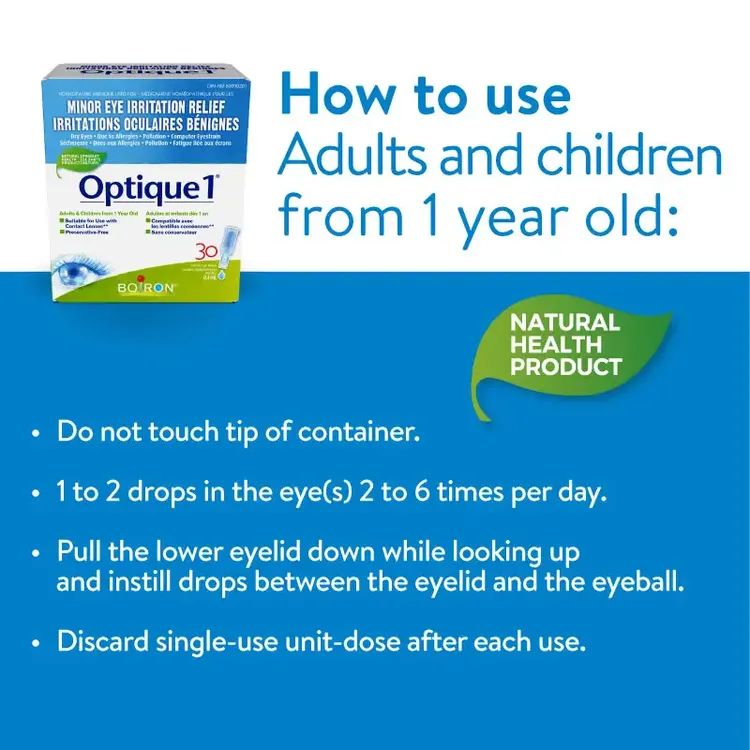
Do not touch tip of container. 1 to 2 drops in the eye(s), 2 to 6 times per day. Pull the lower eyelid down while looking up and instill drops between the eyelid and the eyeball.
Ingredients
Each dose contains:
Calendula offi cinalis
3
DH
Euphrasia offi cinalis
3
DH
Magnesia carbonica
5
DH
Non-medical Ingredients:
Purified water, sodium chloride (0.9 %)
Description
Homeopathic medicine used to relieve minor eye irritations such as dryness, burning sensation, redness or itching due to allergies or pollution (ragweed, pollens, dust, smoke), strain, sustained visual efforts (computer, reading) or swimming.
- 30 Unit-doses of 0.4mL
- Natural health product
- Multi-symptom formula
- Suitable for Use with Contact Lenses **
- Preservative-Free
Frequently Asked Questions
What is Boiron Optique1 and what eye symptoms is it used for?
Boiron Optique1 is a homeopathic eye drop solution (DIN-HM, NPN 80090201) packaged as 30 individual single-dose 0.4 mL preservative-free sterile vials. It contains three active ingredients in homeopathic dilution -- Calendula (marigold) 3 DH, Euphrasia officinalis (eyebright) 3 DH, and Magnesium carbonicum 5 DH -- in a sterile saline base (purified water, sodium chloride 0.9%). It is used for the temporary relief of minor eye discomfort and irritation associated with environmental causes, including: dry eyes, burning, redness, itching from allergies, irritation from pollution, eyestrain from prolonged screen use or reading, and irritation from swimming. It is suitable for adults and children aged 1 and older. Boiron is a French pharmaceutical company founded in 1932 and is the world's largest manufacturer of homeopathic medicines.
What are the ingredients in Boiron Optique1 and what role does each play?
Optique1 contains three active ingredients in homeopathic dilution in an isotonic saline base. Calendula officinalis (marigold) 3 DH: calendula has traditionally been used in botanical medicine for its anti-inflammatory and skin-soothing properties; at 3 DH (third decimal Hahnemannian dilution, equivalent to 1/1000 concentration), it is used homeopathically for eye irritation and minor inflammation. Euphrasia officinalis (eyebright) 3 DH: a plant long used in European herbal and homeopathic traditions for eye conditions; used homeopathically to address symptoms of redness, watering, and eye irritation associated with allergies and environmental exposures. Magnesium carbonicum 5 DH: a mineral compound used in homeopathy; at 5 DH dilution it is used for sensitivity and irritation of mucous membranes. Inactive ingredients: purified water, sodium chloride 0.9% (isotonic saline). The saline base at 0.9% concentration is isotonic with tear fluid, meaning it does not cause osmotic stress to the ocular surface and provides a mild lubricating and rinsing action. The preservative-free single-dose format eliminates the need for preservatives that can themselves cause ocular irritation with repeated use.
Who should use Boiron Optique1 and how should it be used?
Boiron Optique1 is suitable for adults and children aged 1 and older experiencing temporary minor eye discomfort from environmental triggers such as screen time, reading, dust, pollen, pollution, chlorinated swimming pools, and wind. The preservative-free single-dose format makes it suitable for people who use eye drops frequently (more than 4 times per day), as repeated exposure to benzalkonium chloride and other preservatives found in multi-dose eye drop bottles can cause cumulative ocular surface toxicity and paradoxical worsening of dry eye symptoms over time. It is compatible with contact lens use for relief of environmental irritation (though Boiron recommends removing lenses during active eye discomfort). Usage: apply 1-2 drops into the affected eye(s) 2-6 times daily. To use a single-dose vial: twist off the tip, tilt the head back, gently pull down the lower eyelid, and squeeze 1-2 drops into the eye. Discard the vial after use -- do not store an opened vial. Consult a physician if eye symptoms are severe, involve changes in vision, or persist beyond 72 hours, as these may indicate a condition requiring medical evaluation (infection, increased intraocular pressure).
What distinguishes Boiron Optique1 from conventional eye drops and artificial tears?
The most practical differentiator is the packaging format rather than the formula. Optique1 comes in 30 individual single-dose 0.4 mL preservative-free sterile vials -- a format that provides a sterile, uncontaminated dose with every application and requires no preservatives to maintain product safety between uses. Most widely available over-the-counter artificial tears and eye drops (Visine, Bausch + Lomb, Systane, Refresh) are sold in multi-dose bottles preserved with benzalkonium chloride (BAK) or other preservatives that are necessary to prevent microbial growth after the bottle is first opened. BAK preservatives are cytotoxic to corneal and conjunctival epithelial cells and are associated with worsening dry eye disease, meibomian gland dysfunction, and contact lens intolerance with chronic use. The single-dose format of Optique1 is particularly relevant for people who use eye drops more than twice daily, people with pre-existing dry eye disease or ocular surface disease where preservative exposure worsens symptoms, and contact lens wearers. Boiron is a regulated pharmaceutical manufacturer (not a natural health product supplement company), operating under pharmaceutical GMP standards in France. The product holds a Canadian DIN-HM designation, meaning it has been reviewed and authorized by Health Canada under the homeopathic drug framework.
What is Boiron and what does it make?
Boiron is the world's largest homeopathic medicine manufacturer, founded in Paris in 1932 by pharmacist brothers Jean and Henri Boiron. Headquartered near Lyon, France, Boiron operates in approximately 59 countries and has been present in Canada since 1988. Products include single-remedy homeopathic medicines and combination formulas such as Oscillococcinum (flu symptoms), Arnicare (muscle pain), and ColdCalm. Boiron products sold in Canada are registered with Health Canada and carry DIN-HM (Drug Identification Number – Homeopathic Medicine) designation, classifying them as homeopathic drugs rather than supplements.
What makes Boiron different from other homeopathic and natural remedy brands?
Boiron holds a regulatory and historical position no other homeopathic brand can claim: it was the company that successfully lobbied to include homeopathic medicines in the French Pharmacopoeia in 1965, the US Pharmacopoeia in 1982, and the European Pharmacopoeia in 1995. This means Boiron products are manufactured to pharmacopoeia standards — legally binding quality specifications — rather than self-defined practices. In Canada, Boiron products carry DIN-HM drug status rather than NPN. Boiron manufactures remedies at its own production sites in France using in-house pharmaceutical infrastructure, while most homeopathic brands in North America contract manufacture or import non-pharmacopoeia-grade material.
The information provided above is for reference purposes only and has not been reviewed or approved by Health Canada. It does not constitute medical advice and should not replace consultation with a qualified healthcare professional.
Caution
Stop use and ask a health care practitioner if symptoms worsen or persist for more than 48 hours. Do not use if solution changes colour or becomes cloudy. Keep out of reach of children.
Disclaimer
You should not use the information or services on this Site to diagnose or treat any health issues or for prescription of any medication or other treatment.
Always check the product label or packaging prior to using any product. If there are discrepancies, customers should follow the information provided on the product label or packaging.
Boiron, Optique1, 30 Doses
Size
30
doses
UPC
774016840942
Best Before
10/2028
47 people have viewed this item in the last 7 days
$15.49
Quantity
Not enough inventory in stock
Purchase limit exceeded
In-Store Purchases
In stock at LIFEPLUS Natural Health
#1825 - 4720 Mcclelland Rd, Richmond, BC
Free in-store pickup available
Ready by
Tomorrow, Oct 12
⏱️
Shipping Options
Available to ship
Estimate Ship Date
Tomorrow, Oct 12
⏱️
Metro Vancouver
Free Shipping Over $69
Within Canada
Free Shipping Over $99
United States
Mainland China
Starting from $9