• Kills up to 99.99% of bacteria and viruses for fast, targeted throat relief.
• Spray delivers quick, focused application to the sore area for rapid comfort.
• Compact 50 mL bottle with a convenient cap—easy to store at home, in a purse, or on the go.
• Trusted Betadine formula (povidone-iodine) for broad-spectrum antimicrobial action and reliable infection-fighting support.
Popular Searches
Top Brands
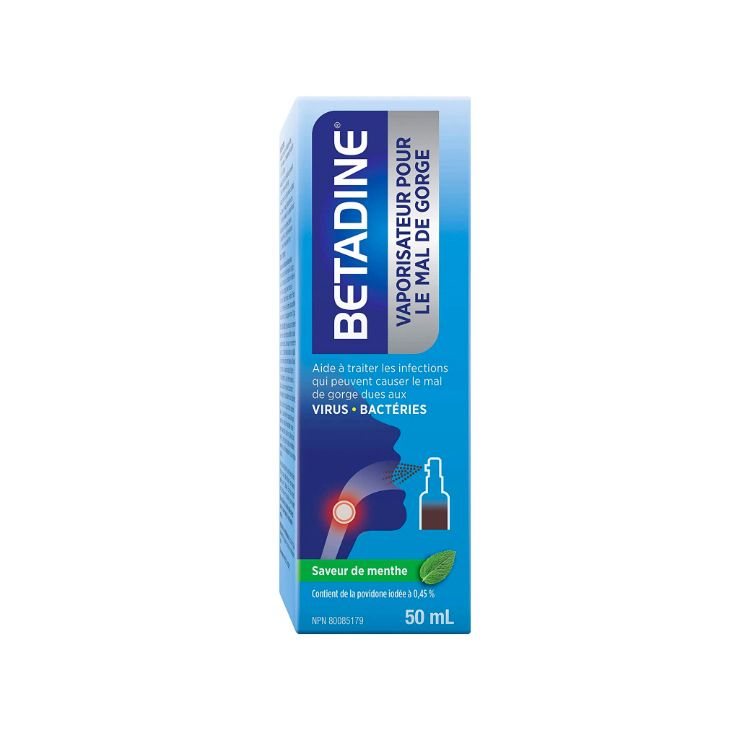
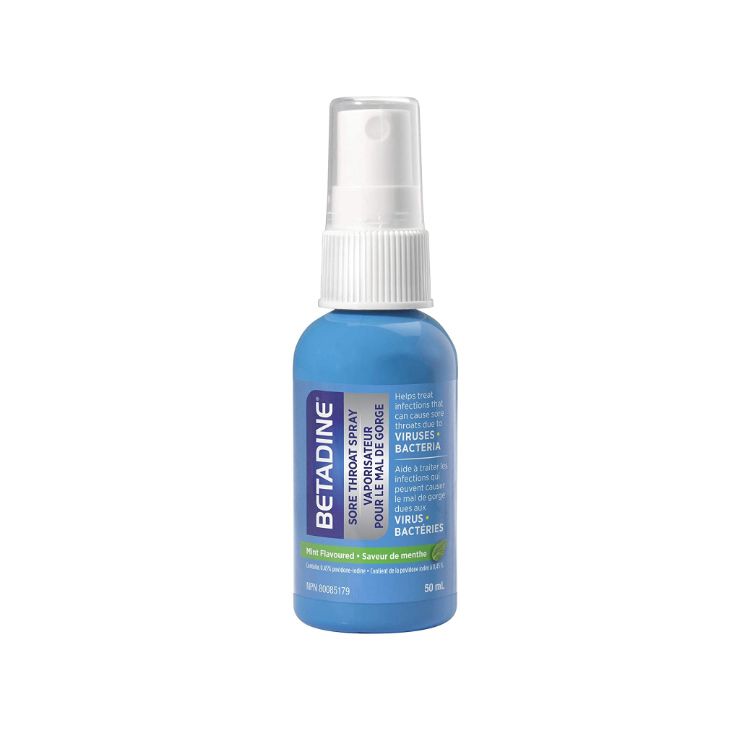
Betadine, Sore Throat Spray, 50 mL
Size
50
ml
UPC
060025427114
56 people have viewed this item in the last 7 days
About this item
Suggested Use
One spray to the throat area, up to 3 times per day. Spit out excess liquid. Rinsing is not necessary. Supervise use with children. Speak to a healthcare professional if symptoms do not improve or worsen after 7 days.
Store at 15ºC to 25ºC.
Store at 15ºC to 25ºC.
Ingredients
Citric acid monohydrate, glycerine, potassium iodide, water.
Description
Find temporary relief for a sore, itchy throat with this BETADINE sore throat spray. The powerful ingredients help kill up to 99.99 percent of bacteria and viruses, and the spray format allows for quick, focused application to the affected area. This formula helps fight infections to leave your throat feeling more comfortable. With a convenient cap and compact packaging, this BETADINE sore throat spray is easy to store in a medicine cabinet, purse or backpack.
Frequently Asked Questions
What is Betadine Sore Throat Spray, and how does it work?
Betadine Sore Throat Spray is a 50 mL antiseptic throat spray containing 0.45% povidone-iodine (PVP-I) as the active ingredient. Povidone-iodine is a broad-spectrum antimicrobial that simultaneously disrupts the cell walls, lipid membranes, and metabolic pathways of bacteria, viruses, and fungi — a multi-target mechanism of action that makes it extremely difficult for pathogens to develop resistance. The spray is used by directing it to the back of the throat, where it acts quickly to kill the majority of bacteria and viruses responsible for sore throats and sore throat symptoms. Laboratory testing confirmed by the University of Malaya's Tropical Infectious Diseases Research and Education Centre (TIDREC) demonstrated that Betadine products kill 99.99% of the SARS-CoV-2 virus in 15 seconds. The formulation also contains glycerin to soothe the mucous membrane and mint for a cooling sensation. Betadine is the registered brand name for PVP-I owned by Mundipharma, a German pharmaceutical group, and has been trusted in hospitals worldwide for over 60 years.
What pathogens does Betadine Sore Throat Spray kill, and is there evidence it works against viruses?
Betadine Sore Throat Spray has documented efficacy against a wide range of pathogens including Gram-positive and Gram-negative bacteria, enveloped and non-enveloped viruses, and fungi. The active ingredient PVP-I kills antibiotic-resistant bacterial strains — an important distinction from antibiotic treatments. On the viral side, published research demonstrates PVP-I activity against rhinovirus and influenza viruses, both common causes of throat irritation and upper respiratory infections. The TIDREC laboratory study published in the British Dental Journal confirmed that Betadine solutions neutralized SARS-CoV-2 (the COVID-19 virus) at 99.99% within 15 seconds in vitro. Betadine's history includes being used by hospitals globally during MERS and SARS outbreaks and being selected by NASA for decontamination of the Apollo 11 capsule in 1969. This combination of bacterial, viral, and fungal coverage makes it relevant for throat discomfort of various microbial origins — not only bacterial infections for which antibiotics are prescribed.
Who can use Betadine Sore Throat Spray, and what are the directions and precautions?
Betadine Sore Throat Spray is approved for use by adults and children aged 6 and over. The recommended dose is to spray directly onto the back of the throat as needed, every 3 to 4 hours, up to a maximum of 3 times per day. It should not be swallowed in large amounts; incidental small swallowing is generally not harmful, but if a significant amount is accidentally ingested, medical attention should be sought immediately. It should not be used by individuals who are allergic to any ingredient, those with any type of thyroid disease, and women who are pregnant or breastfeeding. It should not be used at the same time as hydrogen peroxide products, as the two can interact. The product may discolor dentures or braces — these should be removed before use where possible. Avoid contact with jewelry, especially silver. If allergic reactions such as redness, inflammation, swelling, itching, or rash occur, discontinue use and seek medical care immediately.
How does Betadine Sore Throat Spray differ from other throat sprays and lozenges on the market?
Most throat sprays and lozenges available in pharmacies rely on local anesthetics such as benzocaine or phenol to temporarily numb pain, or on menthol and glycerin to soothe irritation — they do not actively kill the bacteria or viruses causing the throat infection. Betadine Sore Throat Spray is one of the few non-prescription throat products with a documented direct antimicrobial mechanism: PVP-I physically destroys pathogens rather than masking symptoms. This distinction is meaningful for throat discomfort caused by an actual infection rather than environmental irritation. Betadine is also one of the only throat products with published antiviral activity data specifically against coronaviruses, rhinoviruses, and influenza — not just bacteria. As a Mundipharma-registered pharmaceutical, Betadine undergoes rigorous pharmaceutical-grade quality controls that are above the standard for most OTC throat sprays. The compact 50 mL bottle with a pump cap design provides consistent, targeted dosing compared to lozenges, where active ingredient concentration varies as the lozenge dissolves.
What is Betadine and is it safe to use?
Betadine is a trusted antiseptic brand with over 50 years of hospital use worldwide, owned by Purdue Pharma. Its active ingredient is povidone-iodine -- a complex of iodine and polyvinylpyrrolidone (PVP) -- which delivers broad-spectrum antimicrobial action against bacteria, viruses, fungi, and some spores. In Canada, Betadine holds Health Canada NPN 00158291 (1% povidone-iodine Sore Throat Gargle) and is available in multiple formats: sore throat spray (0.45%), gargle (1%), nasal spray, and topical wound solution (5%). The sore throat gargle is approved for adults and children aged 9 and older, up to 4 times daily.
How is Betadine different from other antiseptics like Dettol or Listerine?
Betadine's key distinction is its regulatory classification and mechanism of action. Unlike Dettol (chlorhexidine or chloroxylenol-based) and Listerine (ethanol and essential oils), Betadine uses povidone-iodine -- a molecule that simultaneously disrupts microbial cell proteins, fatty acids, and membranes, rather than targeting a single pathway. This multi-target action makes pathogen resistance harder to develop. Betadine's sore throat formulations are licensed by Health Canada with specific antiseptic health claims, while mouthwash brands are typically regulated only as cosmetics. Research also confirms Betadine's efficacy against rhinoviruses and influenza viruses, extending its use to respiratory mucosa protection.
The information provided above is for reference purposes only and has not been reviewed or approved by Health Canada. It does not constitute medical advice and should not replace consultation with a qualified healthcare professional.
Caution
Small amounts may be swallowed. If accidentally swallowed in large amounts, contact your healthcare professional or hospital immediately. Do not use if you are allergic to any ingredient, have any type of thyroid disorder, if you are pregnant or breast-feeding, or are using hydrogen peroxide. Do not use in children under 6 years of age unless advised by a physician. Consult a healthcare professional immediately if an allergic reaction such as redness, irritation, swelling, itching, or rash occurs. Dentures or braces can sometimes become discoloured – remove if possible before use. Avoid contact with jewellery, especially silver.
Disclaimer
You should not use the information or services on this Site to diagnose or treat any health issues or for prescription of any medication or other treatment.
Always check the product label or packaging prior to using any product. If there are discrepancies, customers should follow the information provided on the product label or packaging.
Betadine, Sore Throat Spray, 50 mL
Size
50
ml
UPC
060025427114
56 people have viewed this item in the last 7 days
$10.49
Quantity
Not enough inventory in stock
Purchase limit exceeded
In-Store Purchases
Not available for immediate pickup
You can order online and pickup in store.
Free in-store pickup available
Ready by
Wednesday, Oct 21
⏱️
Shipping Options
Available to ship
Estimate Ship Date
Wednesday, Oct 21
⏱️
Metro Vancouver
Free Shipping Over $69
Within Canada
Free Shipping Over $99
United States
Mainland China
Starting from $9
Note
Due to the nature of this item, we cannot accept any returns.
Click for more information >>
Click for more information >>