• Clinically proven to defend against colds by trapping and disabling viruses; use at the first sign for best results.
• Creates a protective layer in the nasal cavity to block viruses and help shorten cold duration.
• Helps reduce the spread of cold viruses and moisten the nasal lining to prevent dryness.
• Contains Carragelose (iota-carrageenan), a natural algae-derived ingredient that forms a protective barrier on nasal mucosa.
Popular Searches
Top Brands
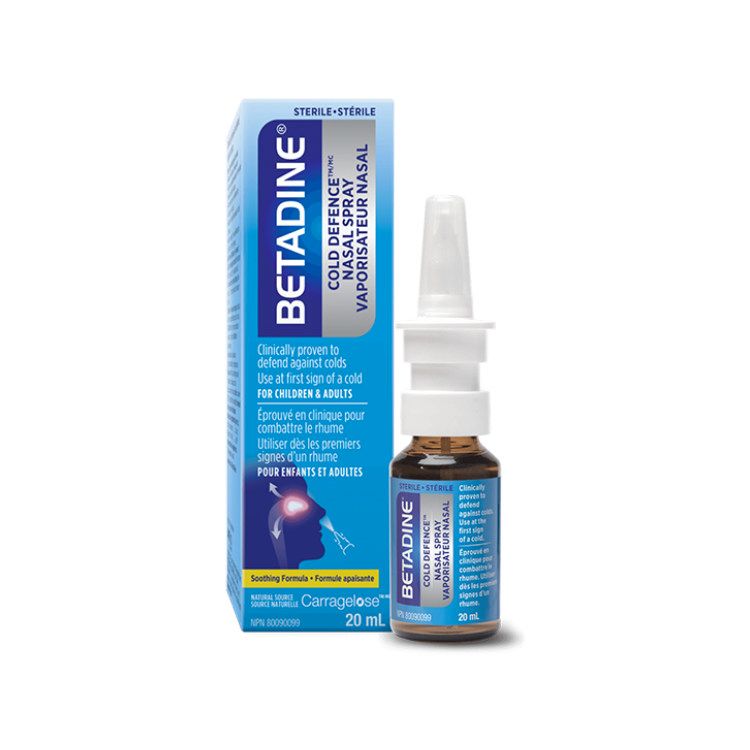
Betadine, Cold Defence Nasal Spray, 20ml
Size
20
ml
UPC
060025429095
96 people have viewed this item in the last 7 days
About this item
Suggested Use
Adults and Children (> 4 years):
At the first sign of a cold: One spray 3 times per day into each nostril.
To moisten dry nasal lining: One spray 1-3 time(s) per day into each nostril.
Children 1-4 years of age: Consult a healthcare practitioner prior to use.
At the first sign of a cold: One spray 3 times per day into each nostril.
To moisten dry nasal lining: One spray 1-3 time(s) per day into each nostril.
Children 1-4 years of age: Consult a healthcare practitioner prior to use.
Ingredients
iota-Carrageenan
1.2
mg
Sodium Chloride
0.5
Percentage
Non-medical Ingredients:
Carrageenan, water.
Description
Clinically proven to defend against colds.
-
Use at the first sign of a cold.
-
Helps treat the common cold by trapping and disabling viruses.
-
Creates a protective layer in the nasal cavity to block viruses.
-
Clinically proven to shorten the duration of a cold.
-
Helps to reduce the spread of cold viruses.
-
Helps moisten the nasal lining to protect it from dryness.
Frequently Asked Questions
What is Betadine Cold Defence Nasal Spray and what is it used for?
Betadine Cold Defence Nasal Spray is a drug-free nasal spray containing iota-carrageenan (1.2 mg per spray) derived from red seaweed, combined with saline (0.5% sodium chloride). Unlike traditional antiseptic Betadine products, this formula contains no iodine -- it uses a physical barrier mechanism rather than a chemical one. It is clinically proven to help defend against the common cold by trapping and disabling cold viruses (rhinoviruses, coronaviruses, and other respiratory viruses) in nasal mucus before they can infect epithelial cells, and to moisten dry nasal lining. It is suitable for adults and children aged 4 and older.
What are the ingredients in Betadine Cold Defence and how does iota-carrageenan work?
Each spray delivers iota-carrageenan 1.2 mg and sodium chloride 0.5% (isotonic saline) in a water base. Iota-carrageenan is a sulfated polysaccharide extracted from the red alga Chondrus crispus and related species. Its antiviral mechanism is physical rather than pharmacological: carrageenan molecules carry a strong negative charge due to their sulfate groups. Respiratory viruses -- including rhinoviruses, influenza viruses, and coronaviruses -- display positively charged proteins on their surface (particularly hemagglutinin and other attachment proteins). When carrageenan contacts these viral surface proteins, electrostatic attraction causes the negatively charged carrageenan to bind to the positively charged viral surface, physically coating the virus and blocking its ability to attach to and penetrate host nasal epithelial cells. Additionally, carrageenan forms a viscous gel layer on the nasal mucosa that traps virus particles, preventing them from reaching cell surface receptors. The saline component provides isotonic moisturization of the nasal lining, which supports mucociliary clearance -- the nose's natural self-cleaning mechanism.
Who should use Betadine Cold Defence and how should it be used?
Betadine Cold Defence is suitable for adults and children aged 4 and older. It is particularly useful for: people at the first sign of a cold, where early use can reduce viral load before infection is established; individuals with high exposure to cold viruses (public transit commuters, office workers, healthcare workers, travelers); parents managing children in daycare or school environments; those who want to reduce the risk of transmitting a cold to vulnerable household members; and people with dry nasal passages from air conditioning, heating, or low humidity environments. Usage: At first sign of a cold -- 1 spray into each nostril, 3 times daily. For nasal moisturization -- 1 spray 1-3 times daily. Children 1-4 years: consult a healthcare practitioner before use. The spray can be used as a daily preventive measure during cold season. It does not require a prescription and has no known drug interactions, as it acts physically rather than systemically. Consult a physician if symptoms persist beyond 5-7 days.
What distinguishes Betadine Cold Defence from other cold prevention and treatment products?
Betadine Cold Defence is distinct from all pharmaceutical cold treatments in its mechanism: it acts physically at the point of viral entry (the nasal mucosa) before infection is established, rather than treating symptoms or modulating the immune response after the virus has already replicated. This is a fundamentally different intervention point. Multiple randomized controlled trials published in peer-reviewed journals have demonstrated that iota-carrageenan nasal spray reduces cold incidence, viral load, and cold duration compared to saline-only control -- a clinical evidence base not available for most natural cold remedies (vitamin C, echinacea, zinc lozenges) which have inconsistent trial results. The physical barrier mechanism also means the product does not interact with medications, does not require systemic absorption, and has no pharmacological activity in any tissue beyond the nasal mucosa -- making it safe alongside any other cold treatments or medications. Unlike decongestant nasal sprays (oxymetazoline, xylometazoline), carrageenan spray does not cause rebound congestion with prolonged use. The Betadine brand trust (recognized for antiseptic quality standards in over 170 countries) supports consumer confidence in product manufacturing quality.
What is Betadine and is it safe to use?
Betadine is a trusted antiseptic brand with over 50 years of hospital use worldwide, owned by Purdue Pharma. Its active ingredient is povidone-iodine -- a complex of iodine and polyvinylpyrrolidone (PVP) -- which delivers broad-spectrum antimicrobial action against bacteria, viruses, fungi, and some spores. In Canada, Betadine holds Health Canada NPN 00158291 (1% povidone-iodine Sore Throat Gargle) and is available in multiple formats: sore throat spray (0.45%), gargle (1%), nasal spray, and topical wound solution (5%). The sore throat gargle is approved for adults and children aged 9 and older, up to 4 times daily.
How is Betadine different from other antiseptics like Dettol or Listerine?
Betadine's key distinction is its regulatory classification and mechanism of action. Unlike Dettol (chlorhexidine or chloroxylenol-based) and Listerine (ethanol and essential oils), Betadine uses povidone-iodine -- a molecule that simultaneously disrupts microbial cell proteins, fatty acids, and membranes, rather than targeting a single pathway. This multi-target action makes pathogen resistance harder to develop. Betadine's sore throat formulations are licensed by Health Canada with specific antiseptic health claims, while mouthwash brands are typically regulated only as cosmetics. Research also confirms Betadine's efficacy against rhinoviruses and influenza viruses, extending its use to respiratory mucosa protection.
The information provided above is for reference purposes only and has not been reviewed or approved by Health Canada. It does not constitute medical advice and should not replace consultation with a qualified healthcare professional.
Caution
If symptoms persist or worsen, consult a healthcare practitioner.
Do not use: if you have a hypersensitivity to carrageenan.
Stop use if: nasal burning, nasal irritation or nausea occurs.
Store under normal conditions, below 25°C. Protect from sunlight. Keep out of the reach of children.
Do not use: if you have a hypersensitivity to carrageenan.
Stop use if: nasal burning, nasal irritation or nausea occurs.
Store under normal conditions, below 25°C. Protect from sunlight. Keep out of the reach of children.
Disclaimer
You should not use the information or services on this Site to diagnose or treat any health issues or for prescription of any medication or other treatment.
Always check the product label or packaging prior to using any product. If there are discrepancies, customers should follow the information provided on the product label or packaging.
Betadine, Cold Defence Nasal Spray, 20ml
Size
20
ml
UPC
060025429095
96 people have viewed this item in the last 7 days
$13.99
Limit 96 per order
Quantity
Not enough inventory in stock
Purchase limit exceeded
In-Store Purchases
Not available for immediate pickup
You can order online and pickup in store.
Free in-store pickup available
Ready by
Tomorrow, Oct 21
⏱️
Shipping Options
Available to ship
Estimate Ship Date
Tomorrow, Oct 21
⏱️
Metro Vancouver
Free Shipping Over $69
Within Canada
Free Shipping Over $99
United States
Mainland China
Starting from $9
Note
Due to the nature of this item, we cannot accept any returns.
Click for more information >>
Click for more information >>